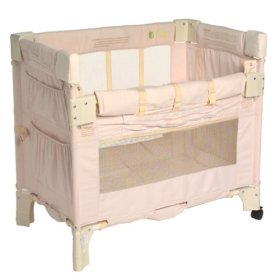
Co-Sleeping - Making It WorkDefinition: Co-sleeping, also called the family bed, is a practice in which babies and young children sleep with one or both parents. Co-Sleeping – Making it Work and Making it Safe - By Elizabeth Pantley, author of Gentle Baby Care Question: We’re expecting our first baby soon and thinking about using a family bed. We’ve done a lot of research on the “whys” ¾ and there’s lots of information out there. But what about the practical tips? How do we set things up? Learn about it The family bed, co-sleeping, shared sleep ¾ no matter what you call it, it means that your baby sleeps with you, or very close to you. The family bed is becoming more and more common (or perhaps it’s always been common but more people are now talking about it.) Sharing sleep is very popular with parents (particularly nursing mothers) of young babies who wake throughout the night, since it allows parents to avoid getting up out of bed and traveling up and down a dark hallway. Co-sleeping is popular also with parents of older babies who enjoy the nighttime closeness with their child. There are as many different styles of family beds as there are families! Here are a few of the typical sleeping arrangements: The family bed: Parents and baby sleep together in one bed ¾ usually king-sized. Side-by-side: The child sleeps on a separate mattress or futon on the floor next to the parent’s bed. Sidecar: A cradle or crib is nestled adjacent to the parent’s bed, sometimes with one side of the crib removed. Shared room: The baby and parents have separate beds in the same room.
The use of these arrangements varies from home to home also. Some of the common sleep situations are: Shared sleep with the baby during the night and for naps.
Part-time shared sleep for either naps or nighttime only, or some of
both, with Mom’s dual beds is a common setup in which Mommy has one place where she sleeps with the baby, and another where she sleeps with her husband. She moves back and forth between beds based on how often the baby wakes up and how tired she is on any given night. Musical beds are a common arrangement. There are several beds in different rooms, and parents and baby shift from place to place depending on each evening’s situation. Occasional family bed is when the baby has her own crib or bed but is welcomed into the parent’s bed whenever she has a bad dream, feels sick, or needs some extra cuddle time. Sibling bed is often a natural followup to the family bed. Older children share sleep after they outgrow the need for the parent’s bed or the sidecar arrangement. How to decide Every family has different nighttime needs. There is no single best arrangement that works for all babies and parents. Even within a family, there may be several “right” options to choose from. The key is to find the solution that feels right to everyone in your family. It’s very important to eliminate your need or desire to satisfy anyone else’s perception of what you should be doing. In other words, no matter what your in-laws, your neighbors, your pediatrician, or your favorite author says about sleeping arrangements, the only “right” answer is the one that works for the people living in your home. Making it safe If you decide to have your baby sleep with you, either for naps or at nighttime, you should adhere to the following safety guidelines: * Your bed must be absolutely safe for your baby. The best choice is to place the mattress on the floor, making sure there are no crevices that your baby can become wedged in. Make certain your mattress is flat, firm, and smooth. Do not allow your baby to sleep on a soft surface such as a waterbed, sofa, pillow-top mattress, or any other flexible surface. * Make certain that your fitted sheets stay secure and cannot be pulled lose.
* If your bed is placed against a wall or other furniture, check every night to be sure there is no space between the mattress and wall or furniture where baby could become stuck. * Infants should be placed between their mother and the wall or guardrail. Fathers, siblings, and grandparents don't have the same instinctual awareness of a baby’s location as mothers do. Mothers, your little one should be able to awaken you with a minimum of movement or noise. If you find that you are such a deep sleeper that you only wake when your baby lets out a loud cry, you should seriously consider moving Baby out of your bed, perhaps in to a cradle or crib near your bedside. * Use a large mattress to provide ample room for everyone’s movement. * Consider a sidecar arrangement in which Baby’s crib or cradle sits directly beside the main bed as one option. * Make certain that the room your baby sleeps in, and any room he might have access to, is child-safe. (Imagine your baby crawling out of bed to explore the house as you sleep. Even if he has not done this — yet — you can be certain he eventually will!) * Do not ever sleep with your baby if you have been drinking alcohol, have used any drugs or medications, are an especially sound sleeper or if you are suffering from sleep deprivation and find it difficult to awaken.
* Do not sleep with your baby if you are a large person, as a
parent’s excess weight has been determined to pose a risk to baby in
a co-sleeping situation. While I cannot give you a specific parent’s
weight to baby ratio, examine how you and Baby settle in next to
each other. If Baby rolls towards you, if there is a large dip in
the mattress, or if you suspect any other dangerous situations, play
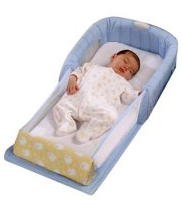
it safe and move Baby to a bedside crib or cradle. * Remove all pillows and blankets during the early months. Use extreme caution when adding pillows or blankets as your baby gets older. Dress Baby and yourselves warmly. (A tip for breastfeeding moms: wear an old turtleneck or t-shirt, cut up the middle to the neckline, as an undershirt for extra warmth.) Keep in mind that body heat will add warmth during the night. Make sure your baby doesn’t become overheated. * Do not wear any night-clothes with strings or long ribbons. Don’t wear jewelry to bed, and if your hair is long, put it up. * Don’t use strong perfumes or lotions that may affect your baby’s delicate senses. * Do not allow pets to sleep in bed with your baby. * Never leave your baby alone in an adult bed unless it is perfectly safe. For example, placing Baby on a mattress on the floor in a childproof room, when you are nearby or listening in with a reliable baby monitor. * As of the now there are no proven safety devises for use in protecting a baby in an adult bed. However, as a result of the great number of parents who wish to sleep safely with their babies, a number of new inventions are beginning to appear in baby catalogs and stores. You may want to look into some of these nests, wedges and cradles. * Make sure that your young baby is sleeping on his or her back – the safest position for sleep. When to make changes Sleeping situations tend to go through a transformation process throughout the early years of a baby’s life. Some families make a conscious decision to co-sleep with their babies until they feel that their children are ready for independent sleeping. Some families make modifications as their babies begin to sleep better at night. Other families move their babies to cribs to accommodate a need for private sleep. The best advice is, go with the flow ¾ and make adjustments according to what works best for you. For more information: Read The No-Cry Sleep Solution: Gentle Ways to Help Your Baby Sleep Through the Night Also Read: Crib Tales - Sleeping With Baby
BPA Free - Baby Safe Products:
|