Below is an interview I did quite some time ago with a lovely woman named Ginger Freebird. I met her on Twitter and became interested in her Squidoo site about Freeganism. I was so intrigued by her amazing story that I interviewed her for a podcast that I used to do (many years ago). I came across the conversation buried deep within the archives of this site and decided to republish. What she does reminds me so much of a movie I watched recently about dumpster diving for food. It’s called Dive!: Living off America’s Waste. It’s fantastic! I so admire folks who take action to rescue perfectly good food so that those who truly need it can benefit. Hope you enjoy!
What exactly is freeganism, for those that don’t know?
Ginger Freebird: Freeganism is a term that was coined from free and from vegan. Freegans live without consuming a lot of things in their lifestyle. Many of them are vegan, which is vegetarian without the dairy. So, they’re looking for strategies to live without buying all the things that Americans think we need to buy. Specifically, getting food from bins behind grocery stores. Fresh food, today’s food, that is sitting there in boxes just out of the fridge, and using that to eat and in my case to feed many of the homeless people.
How exactly did you get started doing this? Would you also call it dumpster diving, or do you prefer one term or the other?
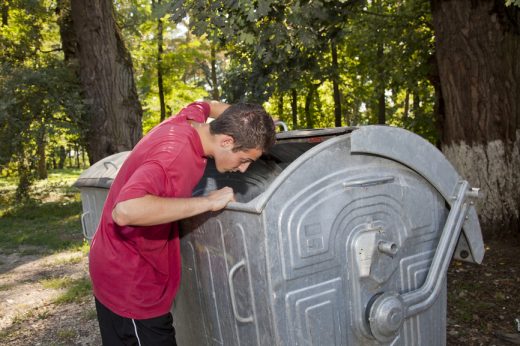
Ginger Freebird: Lately, I’ve come up with the word Food Activist, and Homeless Advocate, Environmentalist, Food Rescuer, a lot of different terms. I don’t actually dive into dumpsters. I think it would be pretty dangerous to actually go in. There is broken glass, there are nails from broken palettes that they stack the food on a lot of times, spaghetti sauce, and cans of open paint that people throw in. Not to mention raccoons and squirrels sometimes. I blame getting started into this lifestyle on Oprah. I’m an Oprah fan. On February 27th, 2008 she had a show about what she called Freegans. These are educated people in New York City that go out at night and find good food in bins and use that for their groceries.
I never thought I’d do something like this. I’ve got college degrees, education. I never thought I’d look in a bin. You think old moldy food, and bugs, and things. But, my curiosity was great. I looked in a local bin behind a grocery store and was shocked to find 6 feet wide, 6 feet deep, 6 feet tall of fresh fruit in boxes just sitting there. And vegetables, broccoli, pineapple, tomatoes, apples, New Zealand kiwi. All sorts of organic vegetables, because they’re more expensive and don’t sell as much. Oranges, grapefruits, celery, strawberries. It was like finding a tree of plenty.
I’ve always been an avid garage sale person. I like a good bargain, and I like recycling and living green. I’ve also always been an avid gardener and vegetable gardener. I like getting my hands dirty and planting seeds, and watching them grow. To see all this beautiful food, these voluptuous vegetables and juicy fruits that were absolutely fine to be thrown away was amazing. So, I just took the boxes out and put them in my trunk. I came home, cleaned them, chopped and froze some and ate them. I’ve had smoothies for 9 months now every day. The most delicious smoothies.
Oprah got me started with my curiosity. Then I got the idea that there’s so much, I’ve got to feed the homeless with this. There are thousands of homeless people in my city. So, I started calling up homeless shelters to see if they needed food. I found two shelters that are open 24 hours a day, 7 days a week to receive food. They don’t ask where it comes from, they can see that it’s good. There are some shelters that have stricter laws and the foods must be packaged, so they will not take fresh fruits and vegetables.
Also, I first called the local police non-emergency line to see what the laws were, if it was illegal to take things out of store bins. They said it really wasn’t and no one had ever been arrested for that. So, I felt more comfortable. You almost feel like you’re stealing or doing something you shouldn’t be doing, because it’s not accepted by society. They think you’re a bum, you’re a desperate person, and it’s disgusting. They don’t see that it’s just like taking everything out of your refrigerator and placing it in a clean plastic bag, putting it in your bin, and then going out in 20 minutes and taking that bag in and putting the items back in your refrigerator. That’s about how disgusting it is.
When I think about taking food from a dumpster behind a store, I’m thinking that they’re throwing out the stuff that’s bad. Has that been your experience? Are you finding perfectly good fresh food in the garbage can that was thrown out for some unforeseen reason?
Ginger Freebird: Yes. I’m finding about 90 percent of it is just fine. The fruits and vegetables may have a small bruise or brown leaf. They just simply have to make room for the new vegetables and fruits coming in, I think. Also, there’s strict policies with yogurts, pizzas, frozen goods, and so on. They will throw it out on the expiration date. But, I have checked with a large food bank and they say that most of these things are good for 6 days after their expiration date, as long as they were kept properly refrigerated at 41 degrees.
I check certain bins often, and then I know that it’s just been thrown out and I can feel that it’s still cold. Then I get it right home and into the fridge or freezer. I sort through. There may be some, often one broken jar of spaghetti sauce in an area. So, it can be a mess at times.
How did you make the leap from just curiosity looking into a couple of these bins to deciding that you were going to make it charitable work?
Ginger Freebird: I’ve always had compassion for homeless people and the less fortunate. I don’t like to see things go to waste, and it just seemed natural to make this connection. To know I’m within half an hour of thousands of people being hungry that can’t get to this food. Then I put a little ad on Craigslist for any drivers that would like to help distribute the food and they would get a free box of food themselves for doing it to help pay for their gas. It’s helped several people that are the working poor, or that want to help out. It came to be that they saw the quality of the food they were getting.
The main comments I got from the shelters were, “There’s so many fresh fruits and vegetables we don’t get from the food banks.” The food banks do a wonderful job and the stores donate to them every day, but there’s still, I’ve estimated conservatively, each store throws away about 500 dollars worth of good fresh food every day, which is 18,000 dollars a month, which is 150,000 a year. A city with 400 stores is 72 million dollars worth of good, usable food.
The problem is getting it quickly. It needs to get quickly to a shelter within an hour or so if it’s a non-refrigerated vehicle in order to stay safe. So, that’s what I’m trying to do is coordinate where we can get it quickly to these places. A runaway teen shelter called me and said, “I hear you’re giving all these good cinnamon rolls, fruits, and vegetables to this other place. Could you please help us out? We’ll send a driver out.” So, they send their own driver out once a week and then they even donated a nice refrigerator to me to have in the garage so that I have two now. I often have about 200 pounds of food every week and I can collect more to give them if I can refrigerate it for a couple of days and not have to gather it all in that one day.
It’s satisfying. There’s something about physically going out and doing this work. It is physically demanding. And then meeting a need, it just feels good. It’s such a nice break from computer work and paper work, and things that take forever. Here you just do something and it’s actually helping people immediately. It feels good.
One story they had that one teenager got a job and needed roller blades to get over there quickly. Because now they have to spend much less on groceries, since I’m providing them they were able to spend 40 dollars on roller blades for him, and he was able to go to work. So, it stopped his cycle of addictions, and problems, and so on. It was a big part of the way he was helped to get a job and change his life.
Another time, I found blankets in the bin. On the weekends, the normal American citizens just throw all their stuff in the bins at stores if they happen to be moving, or happen to have stuff they don’t want.
I found a real sick comforter, it had one rip. I donated it to the shelter. The next week they told me that it kept one boy from having to sleep on the cement floor of the men’s shelter, because there wasn’t room for him elsewhere. So, he got to sleep on that blanket.
In fact, their whole budget has gone from 500 dollars a week that they used to spend on groceries, now they’re spending 50 dollars a week on groceries.
Do you have a rough idea of how much in a monetary value how much you’ve been able to help these homeless shelters?
Ginger Freebird: They’re valuing it at about $450 a week. Then I give it to miscellaneous other ones. I have been keeping a tally. I take pictures of most everything I get, and I keep lists. I put it on Twitter under Twitter.com/freegan, I put down my daily runs, my bun runs, what I’ve got. It’s about 29,000 dollars now in 9 months. This also has been feeding my family, so it’s cut our grocery bill about 300 dollars a month. I only have to get a few things now, everything else is provided.
For me, it’s kind of a sense of adventure. I need something that’s a sense of adventure, and something different. It’s actually a good therapy for depression. It gets you up, and you think, “I’ve got to see what’s in the bin today.” There’s always surprising things. One day I found 26 five pound crates of oranges that were absolutely delicious. I ate about 30 a day, and then gave away hundreds of them.
There are things to keep in mind. If someone is thinking of trying this, definitely make sure it’s okay with the police first. Then go when there aren’t many people around. I suggest taking a car and parking a little ways, usually there’s a parking spot 10 or 20 feet away, and then when no one is around just go and look in.
I use a grabber device, the type that older people use when they can’t pick things up. It’s a 3 foot pole with a handle, then the claws go together. I found there are a lot of cheap ones out there, and a good one is the MedMinds brand that’s found at Walgreen’s for 20 dollars. It pays for itself in about 20 minutes.
You can stand outside the bin, and just lean that in and it will pick up cans and fruits and things. The best days are when it’s stacked high and you can just lift the whole boxes of fruit out, and you don’t have to take it one by one with the grabber. But, it will grab loaves of bread and so on.
The second tool that is needed is some sort of rake or long poled thing that can bring things from the back of the bin to the front, then you can get it with your grabber. Also, I recommend wearing a back brace or back support type of thing, and wrist braces, and old clothes that you don’t mind if they get paint, spaghetti sauce, or ruined.
I wear solid dark clothes just so that I won’t stand out. Tennis shoes and socks to protect my feet. There are nails and glass sometimes around there. I wear a hat and sunglasses. Then I have a nice BMW, so people just think I’m getting a box. The ruse is you just keep an empty box beside you, and if someone does come by you can just take the box and get into your car. They think you’re looking for boxes to move, and that’s socially acceptable.
It’s amazing. Some statistics are that there are about 36 million people in America that are what they call food insecure. They don’t know where their next meal is coming from, or if they’ll have a next meal. About 13 million of those are children. 23 million are adults. Those are older statistics, so I’m sure they’ve increased.
There’s no reason that anyone needs to be hungry in America. We actually already have the food. It’s just a matter of getting the trust of some of these grocery stores and having them take the time to let you have a driver come by and take their 10 sheet cakes instead of seeing them all thrown in the bottom of a bin on top of bread, on top of apples, and other things.
I got all of my Halloween decorations from the bins. Tons of pumpkins. I get about 10 bouquets of flowers a week. I just got 22 herb plants a week ago that I’m nursing back to life and are doing well.
My ultimate goal is to see everyone fed in America. It is feasible to feed everyone. I would like to see the stores actually approve us picking this up. Where we wouldn’t have to get it from a bin, we would be stopping by. I would like to see a network in my city of hundreds of drivers that would be picking up from a store close to them and then it would be coordinated to take to a shelter that’s near them. They would get to keep one box of food themselves and they would get a receipt from the shelter. We’d have it all coordinated and worked out that way.
I am starting the paperwork and I do have some restaurants that do want to work with us, and some caterers. It’s a matter of getting enough drivers that can pick these up at convenient times for the stores and take it immediately to the shelters. That’s feasible to happen. With the food banks they have to send out their drivers to go to all the stores all day long in refrigerated trucks, bring it back, store it at their central area, then sort it all out, then take it later. So they can’t handle all the fresh fruits and vegetables. They do handle some. I see filling a real need with the fresh fruits and vegetables, and then also the bakery items, deli items, and anything else.
Recent Comments