This is part three of my discussion of Everything I Want to Do Is Illegal. 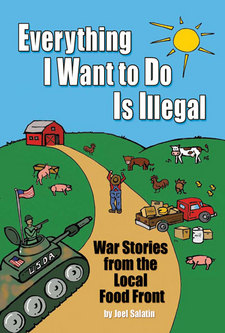 Read part one here and part two here.
When I started reading this book I knew it would make me angry. I was not prepared for how angry it would make me. You may want to take a few kickboxing classes after reading this one. If I get a bit more colorful in this segment you know why…
In chapter 8 Salatin discusses organic certification and how the word has become illegal for him to use. Salatin actually stood in opposition to organic certification because he felt government regulating organic food would be a bad thing and his opinion was not a popular one.
His logic is amazingly clear though and by allowing government to regulate organics we have shot ourselves in the foot. Now the small, ethical, organic farmer has to compete with industrial organic and run the risk of getting smooshed when we all know that industrial organic goes against everything that the word “organic” used to stand for.
I can see it in my mind all the smallish organic farmers thinking they could get some assistance from the government and be able to stick it to large industrial operations that were trying to cash in on the organic fad or squash it so it wouldn’t be a problem for them. Farmers lobbied for organic certification and got it, all the while allowing government to come in and serve as nanny over their operation. “Ha, ha…look at us. We are organic and you aren’t. Now everyone will know our food is better.”
Of course the nanny turned on them and is now changing the rules to allow for industrialized organic and weakened standards. If the consumer had been trusted to make their own decision and choose organic without a fancy certification how much better could it have been? How could big agricorp have fought that battle? Not very easily… but silly little farmers decided to give them leverage. Now big agricorp is saying something like this to the organic farmers, “See that, I am organic now too and everyone will foolishly think my food is just as good as yours…how do you like that biotch?!” Salatin articulates it much better in the book though. ;)
This chapter also discusses why Salatin feels strictly organic is not always better for people or planet.
In chapter 9 we learn about best management practices and specifically how that relates to handling manure. Salatin also shares with us some of his political ideals…such as the fact that he thinks all drugs (yes even crack cocaine and heroine) should be legal. He doesn’t feel that the government should be able to tell us what we can and cannot do with our own bodies. Some of his views were a bit shocking to me but they make sense. It should be no surprise that the government nannies are setting their sights on something we personally care about…we allowed them to get a foot in the door.
Chapter 10 addresses some of the ways that environmentalists have actually harmed the movement towards more sustainable agriculture by not looking at the food system as a whole.
Chapter 11 discusses the fear that people have learned to have toward any food that is not inspected and certified and the government LOVES it. If you don’t see USDA inspected on your food you should rightly expect that it could kill you.
Interestingly Salatin has supplied food to many chefs over the years that completely trust that the food he turns out is better tasting, healthier, and safer than anything that can be bought with a USDA seal of approval. Most gourmet chefs will step outside the USDA safe zone as much as they can. They are willing to stake their livelihood and reputation on it by serving these foods to their customers. That says a lot to me and it should say a lot to everyone.
Salatin points out that the whole system, family farm or government processing facility, depends on personal integrity. And integrity cannot be “policed, legislated, or inspected.”
Any one worker at a food processing plant can taint the food or contaminate it in some way and they are protected by their money and their army of lawyers. A small local farmer does not have that protection or that safety net, so who really has more incentive to turn out a safe product? It makes you think.
At the end of the chapter Salatin talks about how he would like to see local foods get a fair shake for a just a year’s time and see how things turn around. The fact that they can still serve their communities with two hands cuffed behind their back bespeaks the power they already have….the government won’t chance letting that beast get away from them. That is why the consumers need to fight.
Chapter 13 may not be the favorite among environmentalists as it once again talks about how myopic their thinking can be at times. Salatin refers to himself as an environmentalist at times but he sees that there is a big problem today with rabid environmentalists who give no leeway for any viewpoint but their own and who fail to see the whole picture or even include humans in their dream of a perfect world.
Two areas he sees as problems are those of forestry and logging and disposing of predators. Salatin feels that a healthier eco system includes cutting down some trees and that strict no cut zones have actually done more harm than good. It was a rather interesting read. I had never thought about it before but I have to admit that I am not against cutting trees if done in a reasonable and responsible manner. It can be done ethically and with minimal impact so strict no cut policies do not make sense in my mind.
Salatin also points out that wild animals and predators will always be a part of farming and that strict no kill policies harm farmers and what they are trying to accomplish. Wild animals are considered to be the property of the state and therefore not to be harmed. Some species might also be protected. But what is a farmer to do when their livelihood is being attacked by wild predators? They will do what they have to do and I have no issue with that either…but many environmentalists do. I am not against controlled hunting either.
Salatin mentions how he has had to deal with foxes, hawks, bears, and a few other species. Protecting his property and livelihood make some of his actions illegal and that is a shame. In this chapter he recounts how he called the state once and asked them too kindly come out and control their property. It was a hilarious read.
It brought to mind some of my experiences living in Arizona and a little friend I had called The Western Diamondback. They are a protected species and to me that means I cannot go out and hunt them to make myself a snakeskin purse. In my mind it does not mean that when they decided to take up residence on my property (where my kids and dogs played) that I had to set up a little snake condo for them and get used to some sort of cohabitation arrangement and basically hide indoors for the rest of our lives. Nope…my response to them was something along the lines of what Al Pacino said in Scarface… “Say hello to my little friend…” Does that make me a pseudo environmentalist or a big meanie? Not in my mind. Protecting animal species is all well and good but you can’t narrowly take humans out of the picture. There needs to be some balance or the state really does need to be at our beck and call whenever their property gets a little unruly. ;)
Oh boy… is this a book that doesn’t end?! Stay tuned for part 4.
Recent Comments